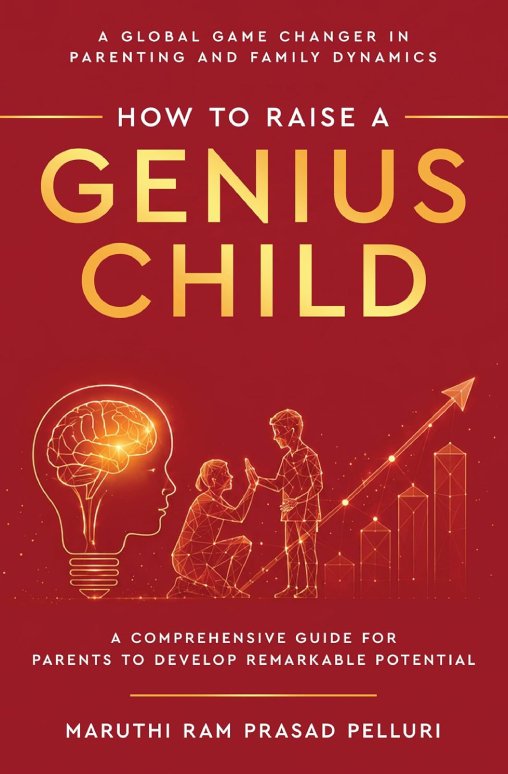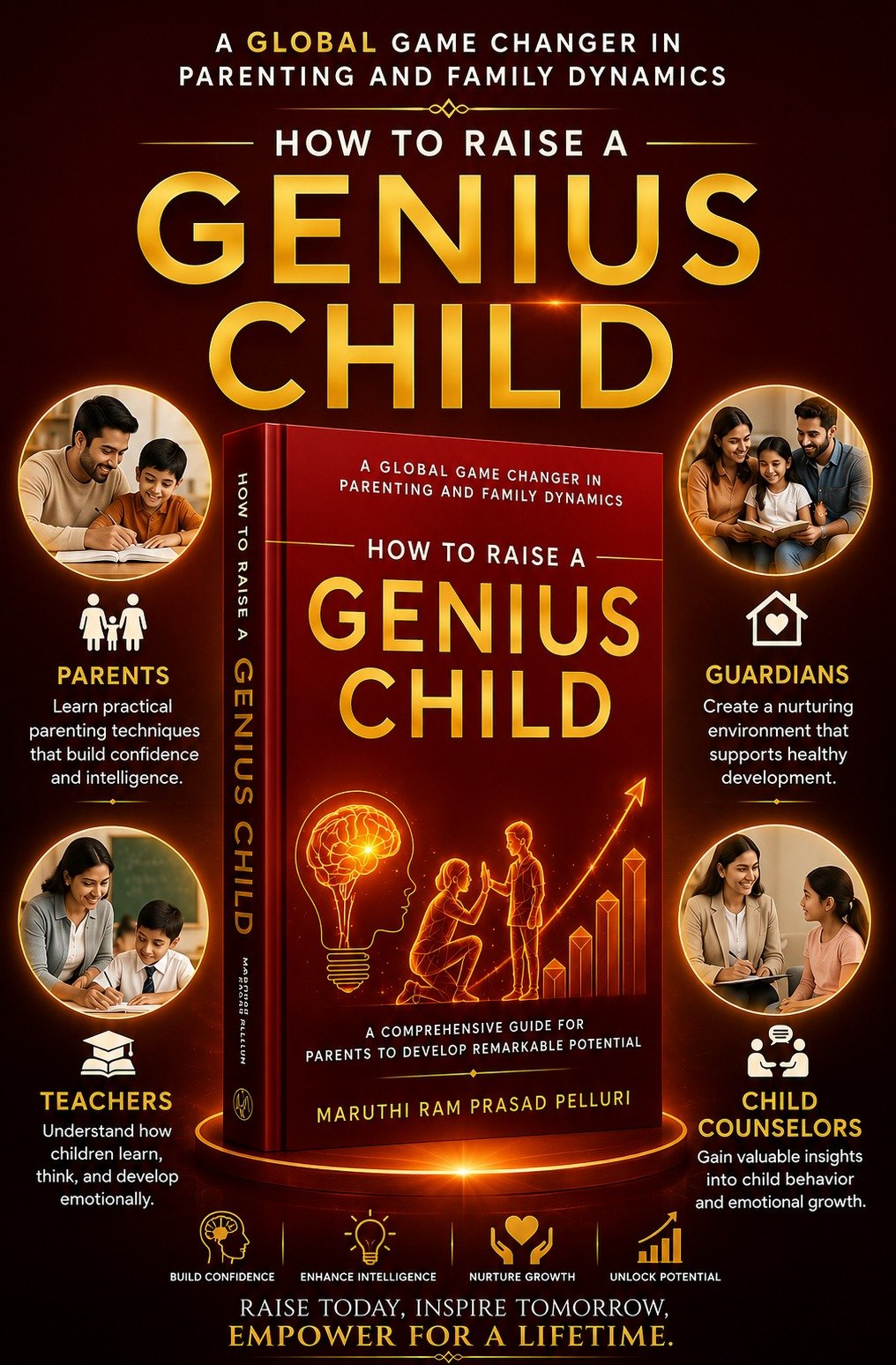
Supplies
July 20, 2026 2026-08-07 15:49Supplies

Trusted Strategies That Thousands of Parents Can Apply in Just 15 Minutes a Day
Empower your child with the right mindset, emotional intelligence, creativity, and lifelong learning habits. This comprehensive guide helps parents nurture confident, intelligent, and successful children in today's rapidly changing world.
👉 Best for Parents
👉 Teachers & Educators
👉 Child Development Enthusiasts
The Book that unlocks your child's inner genius
- Free Shipping
- Secure Payments
- Easy Returns
Inspiring Excellence in Education
Maruthi Ram Prasad is a renowned educationist, teacher trainer, and academic leader with over 30 years of experience in school education and leadership. Having served as Principal, Academic Director, and educational consultant for leading CISCE and Cambridge schools, he is recognized globally for his contributions to education. A recipient of the Indian Achievers' Award 2024–25 and named among the Top 100 Global Educational Leaders, he is the Founder Principal & Academic Director of The Suraka School, Hyderabad, dedicated to nurturing future-ready learners.
Maruthi Ram Prasad
- Author
Maruthi Ram Prasad
- Author
Why This Book?
Parenting has never been more challenging. Children today face distractions, academic pressure, emotional struggles, and a fast-changing digital world.
"How to Raise a Genius Child" provides practical, research-based strategies to help parents build strong relationships, develop creativity, improve emotional intelligence, and create an environment where children naturally thrive.
This book isn't about creating perfect children it's about helping every child discover and maximize their unique potential.
Why This Book?
Parenting has never been more challenging. Children today face distractions, academic pressure, emotional struggles, and a fast-changing digital world.
"How to Raise a Genius Child" provides practical, research-based strategies to help parents build strong relationships, develop creativity, improve emotional intelligence, and create an environment where children naturally thrive.
This book isn't about creating perfect children—it's about helping every child discover and maximize their unique potential.
What You'll Learn
Build your child's confidence naturally
Develop creativity and problem-solving skills
Build positive parent-child relationships
Encourage independent thinking
Create healthy learning habits
Improve emotional intelligence
Reduce stress and academic pressure
Improve communication with your child
Develop leadership qualities
What You'll Learn
Build your child's confidence naturally
Develop creativity and problem-solving skills
Improve emotional intelligence
Encourage independent thinking
Create healthy learning habits
Build positive parent-child relationships
Reduce stress and academic pressure
Improve communication with your child
Develop leadership qualities
Who Should Read This Book?
13 Chapters. One Complete Roadmap.
Positive Parenting
Early Indicators

Home As A Learning Space

Emotional Intelligence

Creative Play

Asking Questions

Academic Excellence

Tools for Young Minds

Social Skills

Providing Support

Identifying Challenges

Recognising Milestones

Continual Progression
Positive Parenting
Early Indicators
Home As A Learning Space
Emotional Intelligence
Creative Play
Asking Questions
Academic Excellence
Tools for Young Minds
Social Skills
Providing Support
Identifying Challenges
Recognising Milestones
Continual Progression
📖 Detailed Book Chapters
Explore the complete learning journey designed to help every parent and educator nurture children's intelligence, creativity, confidence, discipline, and future success.
- Brain development stages
- Early learning techniques
- Memory improvement
- Focus & concentration
- Learning through play
- Daily Brain Development Activities
- Printable Worksheets
- Reading Habit Planner
- Child Progress Tracker
- Learning Assessment Checklist
- Parenting Action Plan
- Confidence Building Exercises
- Success Routine Templates
Core philosophy
Genius isn't born. It's grown.
Think of your child as a seed. The genetic code sets possibilities but the soil, sun, and water you provide determines whether that potential fully blooms.
Every child is born a genius. The problem? Most of us never learn how to unlock it. If you’ve ever wondered, “Is my child living up to their potential?” This book gives you the answer and the roadmap. Because genius isn’t taught. It’s uncovered..
Core philosophy
Genius isn't born. It's grown.
Think of your child as a seed. The genetic code sets possibilities — but the soil, sun, and water you provide determines whether that potential fully blooms.
Every child is born a genius. The problem? Most of us never learn how to unlock it. If you’ve ever wondered, “Is my child living up to their potential?” This book gives you the answer and the roadmap. Because genius isn’t taught. It’s uncovered..
Loved by thousand of Parents
As both a teacher and a mother of a socially anxious child, Chapter 9 was deeply personal. The scripts for empathy-based discipline — asking 'how do you think she felt?' instead of assigning blame — work better than anything I've tried in 8 years of teaching.
As a stay-at-home dad I sometimes doubt whether I'm doing enough. Recognising that my 3-year-old's obsessive focus on trains isn't 'just a phase' but a genuine sign of deep interest — and knowing how to nurture it without over-scheduling him — was exactly what I needed.
I've recommended this to every teacher in our school and made it part of our professional development reading list. Maruthi Ram Prasad brings over 30 years of real school leadership — this isn't theoretical. The sections on identifying gifted students in mixed-ability classrooms are especially relevant.
Why Parents Trust This Book
10,000+
Happy Parents
Fast
Delivery
4.9/5
Ratings
500+
Schools
100%
Secure Payment
Top-Rated Selection
Premium Quality
Frequently Asked Questions
Both matter — and they are inseparable. Think of a child as a seed. The genetic code sets certain possibilities, but the soil, sunlight, and water — the environment — determines whether that potential is fully realised. A child with a musical gene may develop remarkable ability in a home full of music, while another child with the same genetic potential may never discover that gift in a quieter household.
The research is clear: pressure to reach 'full potential' can lead to anxiety, perfectionism, and burnout — especially when the child begins to define their entire identity around being 'the smart one.' True genius isn't about achieving a specific goal — it's about nurturing curiosity and creativity. History's greatest minds all had failures and setbacks.
- Focus on effort and curiosity, not outcomes and grades.
- Celebrate the process of learning, including mistakes and restarts.
- Encourage exploration across many domains — don't over-specialise too early.
- Protect time for unstructured creative play — it is not wasted time.
Questions are the engines of deep learning. They build brain connections that allow children to break down, combine, and evaluate information — what researchers call 'deep learning experiences.' True brilliance lies not in having all the answers but in knowing how to ask meaningful questions. Adults who model curiosity — openly admitting 'I don't know, let's find out together' — teach children that lifelong learning is an adventure.
- Ask open-ended questions that can't be answered with yes or no.
- When children ask something you don't know, explore it together first rather than immediately searching online.
- Respond to their questions with another question: 'What do you think might happen if...?'
Emotional intelligence is not separate from genius — it is a core component of it. Children who understand feelings recover more easily from setbacks, adapt more readily, build stronger relationships, and are better equipped to seize opportunities. Children learn emotional skills through the adults around them. When parents and teachers show care, listen attentively, and talk openly about feelings, children absorb these skills by watching.
- Create a safe space for emotions: let children know it's always okay to feel and that sharing feelings is welcomed.
- Practise emotion-naming daily: 'It sounds like you're frustrated. Is that right?'
- Use emotion cards with young children — matching faces to feelings makes it tangible.
- Talk about your own emotions: 'I felt nervous about that meeting today. Here's how I handled it.'
- Ask reflective questions: 'What do you think made you feel that way?'
Social skills are learnt, not innate — and every child moves at their own pace. Practical strategies at home are highly effective, especially when they are consistent and positive.
- Positive reinforcement for sharing: Be specific and immediate — 'I'm so proud of you for sharing your snack just now. That was very kind.'
- Role-play social scenarios: Practise greetings, introductions, asking to join a group, and resolving disagreements.
- Empathy-based conversations after conflict: 'How do you think your friend felt when that happened?'
- Involve them in solving conflicts: 'What do you think we could do next time to avoid this problem?'
- Start small: Begin with one-on-one playdates before larger group settings.
Mozart's father recognised his son's musical potential early and nurtured it with care — creating one of history's most celebrated composers. But the key word is 'nurtured,' not 'forced.' When a child's passion comes from within, your role is to provide access, encouragement, and the right environment. When a child feels pushed toward a passion that is actually a parent's aspiration, the results are usually the opposite of what was hoped for.
- Follow the child's energy, not your ambition for them.
- Provide materials and opportunities without demanding outcomes: 'Here's a sketchbook — use it however you like.'
- Celebrate progress and effort, not performance or product.
- Allow them to change direction — exploring multiple passions is healthy, not wishy-washy.
- Protect time for unstructured exploration; over-scheduling kills intrinsic motivation.
The ultimate measure of raising a genius child, as the book argues, is not the awards they receive or the praise they hear. It is how happy and at peace they are as they pursue what they love. A truly well-raised child combines academic ability with emotional intelligence, social skill, resilience, creativity, and a genuine love of learning. These qualities don't develop through pressure — they develop through a relationship of trust, curiosity, and unconditional support.
- Value the whole child: Celebrate emotional milestones as enthusiastically as academic ones.
- Make room for joy: Learning should complement childhood joy, not overshadow it.
- Nurture character alongside capability: Kindness, empathy, and resilience are not soft skills — they are the architecture of a meaningful life.
- Build a relationship of trust: A child who feels known and loved for who they are is more likely to reach their full potential than one raised under pressure.
Why Parents Trust This Book
10,000+
Happy Parents
Fast
Delivery
4.9/5
Ratings
500+
Schools
100%
Secure Payment
Top-Rated Selection
Premium Quality
Frequently Asked Questions
Both matter — and they are inseparable. Think of a child as a seed. The genetic code sets certain possibilities, but the soil, sunlight, and water — the environment — determines whether that potential is fully realised. A child with a musical gene may develop remarkable ability in a home full of music, while another child with the same genetic potential may never discover that gift in a quieter household.
The research is clear: pressure to reach 'full potential' can lead to anxiety, perfectionism, and burnout — especially when the child begins to define their entire identity around being 'the smart one.' True genius isn't about achieving a specific goal — it's about nurturing curiosity and creativity. History's greatest minds all had failures and setbacks.
- Focus on effort and curiosity, not outcomes and grades.
- Celebrate the process of learning, including mistakes and restarts.
- Encourage exploration across many domains — don't over-specialise too early.
- Protect time for unstructured creative play — it is not wasted time.
Questions are the engines of deep learning. They build brain connections that allow children to break down, combine, and evaluate information — what researchers call 'deep learning experiences.' True brilliance lies not in having all the answers but in knowing how to ask meaningful questions. Adults who model curiosity — openly admitting 'I don't know, let's find out together' — teach children that lifelong learning is an adventure.
- Ask open-ended questions that can't be answered with yes or no.
- When children ask something you don't know, explore it together first rather than immediately searching online.
- Respond to their questions with another question: 'What do you think might happen if...?'
Emotional intelligence is not separate from genius — it is a core component of it. Children who understand feelings recover more easily from setbacks, adapt more readily, build stronger relationships, and are better equipped to seize opportunities. Children learn emotional skills through the adults around them. When parents and teachers show care, listen attentively, and talk openly about feelings, children absorb these skills by watching.
- Create a safe space for emotions: let children know it's always okay to feel and that sharing feelings is welcomed.
- Practise emotion-naming daily: 'It sounds like you're frustrated. Is that right?'
- Use emotion cards with young children — matching faces to feelings makes it tangible.
- Talk about your own emotions: 'I felt nervous about that meeting today. Here's how I handled it.'
- Ask reflective questions: 'What do you think made you feel that way?'
Social skills are learnt, not innate — and every child moves at their own pace. Practical strategies at home are highly effective, especially when they are consistent and positive.
- Positive reinforcement for sharing: Be specific and immediate — 'I'm so proud of you for sharing your snack just now. That was very kind.'
- Role-play social scenarios: Practise greetings, introductions, asking to join a group, and resolving disagreements.
- Empathy-based conversations after conflict: 'How do you think your friend felt when that happened?'
- Involve them in solving conflicts: 'What do you think we could do next time to avoid this problem?'
- Start small: Begin with one-on-one playdates before larger group settings.
Mozart's father recognised his son's musical potential early and nurtured it with care — creating one of history's most celebrated composers. But the key word is 'nurtured,' not 'forced.' When a child's passion comes from within, your role is to provide access, encouragement, and the right environment. When a child feels pushed toward a passion that is actually a parent's aspiration, the results are usually the opposite of what was hoped for.
- Follow the child's energy, not your ambition for them.
- Provide materials and opportunities without demanding outcomes: 'Here's a sketchbook — use it however you like.'
- Celebrate progress and effort, not performance or product.
- Allow them to change direction — exploring multiple passions is healthy, not wishy-washy.
- Protect time for unstructured exploration; over-scheduling kills intrinsic motivation.
The ultimate measure of raising a genius child, as the book argues, is not the awards they receive or the praise they hear. It is how happy and at peace they are as they pursue what they love. A truly well-raised child combines academic ability with emotional intelligence, social skill, resilience, creativity, and a genuine love of learning. These qualities don't develop through pressure — they develop through a relationship of trust, curiosity, and unconditional support.
- Value the whole child: Celebrate emotional milestones as enthusiastically as academic ones.
- Make room for joy: Learning should complement childhood joy, not overshadow it.
- Nurture character alongside capability: Kindness, empathy, and resilience are not soft skills — they are the architecture of a meaningful life.
- Build a relationship of trust: A child who feels known and loved for who they are is more likely to reach their full potential than one raised under pressure.